

In this article we will introduce you to key customer & industry trends, niche innovations in the food sector and display how materiality assessment can prepare you for sustainable strategy development.
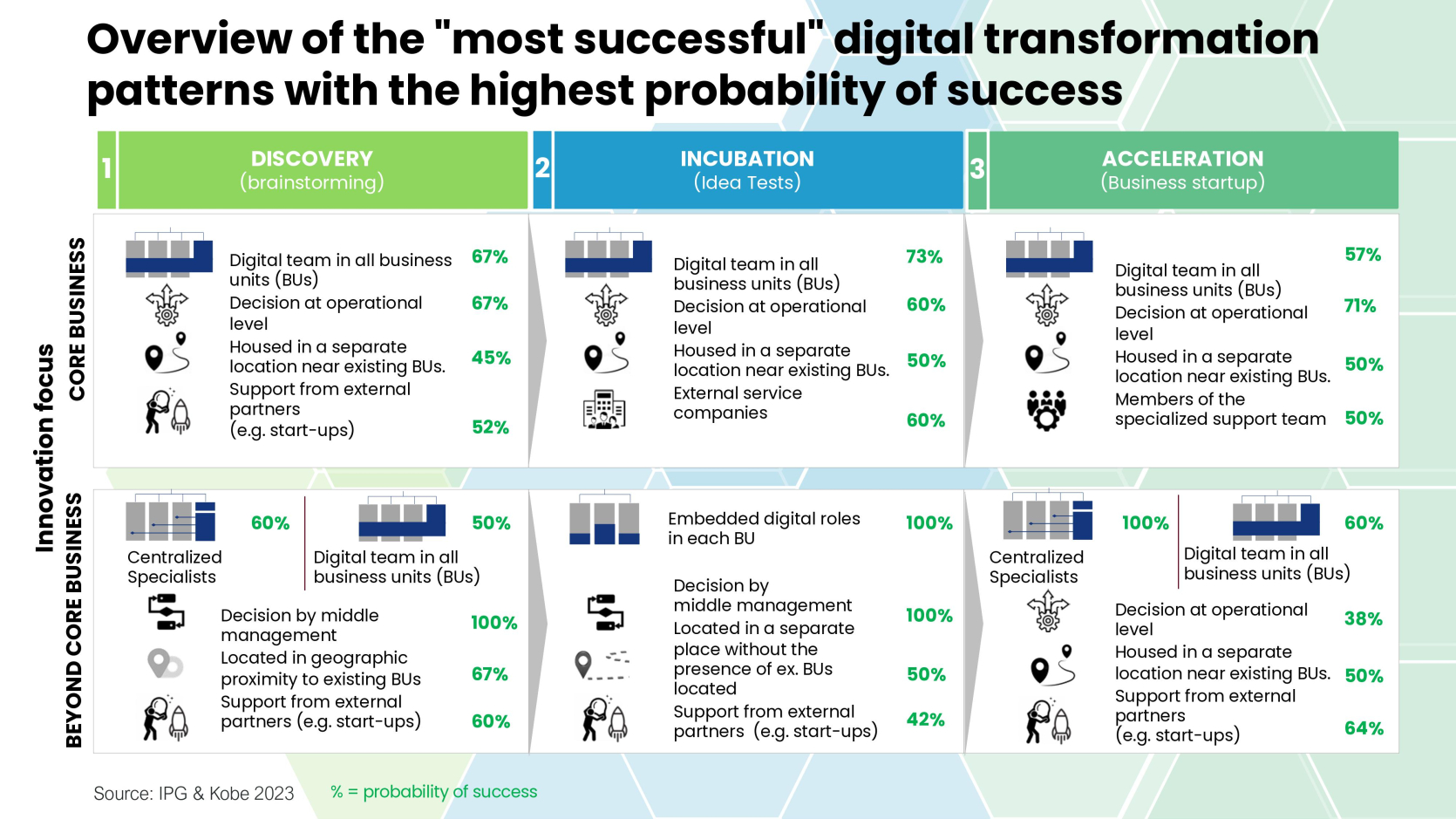
Are you ready to revolutionize your business model through digital transformation? A study conducted by SWISS-IPG and Kobe Research & Consulting has uncovered key insights into organizational strategies that drive success in the dynamic realm of digital innovation. Let's dive into the findings and discover the winning patterns!

IPG launches TWIN-PRO accelerator program for sustainable and digital procurement

One-third of manufacturers are hampered by “technology paralysis” that is preventing the success of their smart manufacturing efforts.

The days of burying ESG data and tweaking SEO to cover up sustainability scandals is over. The driving imperative of these new AI’s is to answer the question asked. So, have you openly and thoroughly answered people’s sustainability questions - before an AI can do it for them?

Connected intelligence in manufacturing refers to a mesh of models and smart devices that integrate real-time analytics into business operations, helping organizations process their current and historical data to provide actionable insights.

Dan O’Connell, the Chief Strategy Officer at Dialpad, explains how businesses can leverage natural language processing to enhance a range of industries.

There’s huge potential for 5G networks to help create truly smart factories when used in automation, artificial intelligence, augmented reality, robotics, cloud, mobile broadband, edge, quantum computing and the Internet of Things (IoT).

Supply cost fluctuations, constant changes in consumer behavior, and fierce competition make the manufacturing business more challenging than ever. Fortunately, the emergence of predictive analytics in manufacturing helps enterprises make data-driven decisions and stay ahead of the competition using more precise forecasting.

The world's first carbon border tax, or CBAM – the Carbon Border Adjustment Mechanism – could have important implications for the global economy.
INNOVATIVE PARTNERS TOP INSIGHT – NEWSLETTER SUBSCRIPTION
With our latest TOP INSIGHTS we want to let you take part in our work and give you an overview about
latest industry topics, trends and innovations which will shape future business environments.
Keep your finger on the pulse on innovation, digitalization and technology!
Please subscribe and confirm via Email.
You can unsubscribe any time via the link provided in our Newsletter.
The information that you provided above will be processed according to the SWISS IPG PARTNERS GROUP Privacy Policy.