Search blog, projects, service or people.

IPG PARTNERS GROUP is an international transformation and innovation consultancy helping organizations INNOVATE, PERFORM and GROW. With our TWIN Transformation approach, we connect digitalization and sustainability with business model innovation, operating model and process transformation, procurement & supply chain excellence, and people & capability development. Through our Innovative Partners.World and Cross Innovation approach, we provide access to leading expertise, technologies and implementation capabilities worldwide – turning transformation ambition into measurable business impact.

Contact Info

Follow us

Drag

Digital Use Case Library

IPG DIGITAL USE CASES LIBRARY

With the IPG AI-platform, you can explore, evaluate and prioritize 1.000+ proven AI use cases tailored to your company for stronger, faster AI outcomes

IPG´s AI-platform supports to discover AI opportunities tailored to individuel business requirements

Cluster
Process
Process phase
Use case
Business Requirement
INNOVATE
Readiness &
Capability Check 1
Trends &
Drivers 2
Ambition &
Values 3
Hotspots
Analysis 4
Use Cases &
Requirements 5
Target
IT Framework 6
Roadmap &
Business Case 7
Mobilization &
First Skill Ups 8
AI & Data-EXPLORER
AI platform for digital use cases, tools and solution providers
Best-Fit Matching
Ambition
→
Hotspots
→
Use Cases &
Business Requirements
→
Best-Fit
IT & AI Solutions
→
Best-Fit
Solution Provider
Community & Ecosystem
Recruiting & Interim Management
Change Management
Skill Up Academy
Target Operating Model
Performance & Reporting
Digital Execution Framework
GROW
PERFORM
50+
AI core use case
with
1,000+
single sub-use cases

Rapidly identify AI opportunities

Review an ever-expanding library of 1,000+ single AI sub-use cases for digital and sustainable Procurement & Supply Chain transformation to surface those most relevant to your needs.

Built-in AI Expertise and Case Studies

Evaluate each AI use case based on IPG expert assessment of projected business value and complexity of implementation — informed by proprietary research and real-world adoption data.

AI Prioritization Framework

AI agents, interactive dashboards and scorecards support ranking, comparison and shortlisting of AI use cases based on individual ambition, goals, risk appetite and readiness.

THE IPG DIFFERENCE

Technology does not drive transformation. Better decisions do.

The IPG AI-platform combines transformation expertise, AI and data, market and solution intelligence, digital platforms and implementation capability.

AI & Data
Explorer
+
Expert
Knowledge
+
Business Transformation
Services
+
Digital Tools
& Platforms
+
Implementation
Capabilities

Better intelligence. Better decisions. Faster impact.

IPG DIGITAL

The blueprint defines the journey.
Our AI-platform accelerates the decisions.

The IPG AI-platform brings data, market intelligence, AI and tool expertise to the critical choices inside that structure.

Hotspots

Business problems

Use cases

Digital opportunities

Requirements

Functional needs

Digital Tools

Best-fit tools

Solution
Providers

Best-fit partners

PoC & ROI

Validated value

digital use case library

IPG covers all relevant application areas and use cases for the digitalization of enterprise-wide value creation.

Explore example below

IPG DIGITAL USE CASE LIBRARY

Use Case Library “Digital Procurement”

30 high-priority digital procurement use cases structured across six capability domains — from transactional excellence and data foundations to sourcing, risk, supplier management and cost engineering.

30 Use Cases
Enable
1

Touchless P2P

Enable largely automated Purchase-to-Pay processes from demand initiation through invoice processing with minimal manual intervention.

2

PO Processing

Digitally create, transmit, confirm and monitor purchase orders while efficiently managing order changes and deviations.

3

Invoice Automation

Automate invoice capture, matching, validation, approval and payment initiation to reduce manual processing effort and errors.

4

Marketplace

Provide digital purchasing platforms for standardized requirements, catalogs, services and long-tail spend across the organization.

5

Multidomain MDM / iPaaS

Establish a shared data and integration foundation for master data, interfaces and end-to-end process connectivity.

Understand
6

Spend Data Analytics

Analyze spend, prices and supplier data to create transparency on purchasing volumes, risks, performance and value opportunities.

7

Market Intelligence

Systematically collect and use market, price, supplier and risk intelligence to support procurement decisions and strategies.

8

Category Strategy

Develop data-driven category strategies, scenarios, initiatives and roadmaps based on internal and external market intelligence.

9

SC Planning & Forecasting

Improve demand, supply and inventory planning through forecasts, market signals, scenarios and data-driven planning models.

10

Continuous Planning

Continuously update procurement and supply plans as requirements, risks, capacities and market conditions change.

Source
11

Digital Assistant

Support procurement users with digital assistants for analysis, research, decision support and recurring operational tasks.

12

Intake & Orchestration

Capture business requirements in a structured way and automatically guide users toward the most appropriate procurement channel and process.

13

S2C

Integrate Source-to-Contract processes from demand identification and RFx through supplier selection, award and contracting.

14

Autonomous Sourcing

Automate the preparation, execution and evaluation of sourcing events for suitable categories, requirements and supplier markets.

15

Negotiation Preparation

Prepare supplier negotiations systematically using data, benchmarks, objectives, scenarios and structured argumentation.

16

Autonomous Negotiations

Use digital negotiation bots to autonomously conduct standardized price and commercial term negotiations with suppliers.

Protect
17

Supplier Risk

Identify, assess and continuously monitor supplier risks while initiating targeted measures to reduce exposure and improve resilience.

18

Multi-tier Visibility

Create transparency across upstream supply chains, critical sub-suppliers, materials, dependencies and potential disruption points.

19

Compliance / ESG Screening

Screen suppliers against compliance, ESG, sanctions and sustainability requirements using structured internal and external data.

20

Scope 3 Carbon Mgmt / PCF

Capture, calculate, analyze and reduce Scope 3 emissions and Product Carbon Footprints across suppliers and value chains.

Manage
21

Supplier Discovery

Identify suitable suppliers based on capabilities, regions, technologies, risks, market sources and specific sourcing requirements.

22

SIM

Centrally manage supplier master data, profiles, documents, certifications and other relevant supplier information.

23

Supplier Qualification Mgmt

Qualify new and existing suppliers systematically based on defined criteria, documentation, assessments and approval workflows.

24

CLM

Manage the contract lifecycle from creation, review and approval through storage, obligations and deadline monitoring.

25

SPM

Measure and manage supplier performance using KPIs, scorecards, reviews, improvement actions and structured escalation processes.

26

SQM

Manage supplier quality through audits, complaints, corrective actions, quality KPIs and continuous improvement processes.

27

SRM

Strategically manage supplier relationships, development, collaboration, governance and long-term value creation.

Optimize
28

Should Costing

Develop data-driven target and should-cost estimates for products, materials, components and supplier quotations.

29

Design-to-Source

Integrate procurement and suppliers early into design decisions to optimize cost, manufacturability, sourcing options and supply security.

30

Technical Drawing Analysis

Analyze technical drawings to derive cost, material, manufacturing and sourcing information for procurement and engineering decisions.

Proprietary IPG methodology. Reproduction, adaptation or commercial use requires prior written permission from IPG Partners Group.


IPG DIGITAL USE CASE LIBRARY

Use Case Library “Digital SCM”

37 high-priority digital supply chain use cases structured across six capability domains — from planning and supplier collaboration to risk management, execution, end-to-end orchestration and circular supply chains.

37 Use Cases
Plan
1

Demand Forecasting

Forecast future customer and sales demand based on historical data, trends, seasonality and external market signals.

2

Demand Sensing

Detect short-term demand changes using real-time data, market impulses and operational signals to improve planning responsiveness.

3

S&OP / IBP

Align demand, supply, capacity and financial plans within one integrated cross-functional planning and decision process.

4

Inventory Optimization

Optimize inventory and safety stock levels according to service targets, working capital requirements, demand variability and risk.

5

Supply Planning

Plan procurement, production and supply considering demand, capacity, material constraints and service requirements.

6

Network Design

Optimize locations, material flows and capacities across the supply network to balance cost, service and resilience.

Collaborate
7

Supplier Collaboration

Digitally collaborate with suppliers on forecasts, capacities, orders, constraints and joint improvement actions.

8

Capacity Visibility

Create transparency on current and expected supplier capacities to identify bottlenecks and capacity risks at an early stage.

9

Material Availability

Create transparency on material availability, coverage, shortages and critical supply situations across the supply chain.

10

Multi-Sourcing

Secure critical requirements through multiple qualified sourcing alternatives across suppliers, regions and supply markets.

11

Supplier Network Mapping

Map suppliers, locations, relationships and dependencies across multiple tiers of the supply network.

Protect
12

Multi-Tier Risk

Identify and assess risks at sub-suppliers, critical nodes and dependencies beyond the direct Tier-1 supplier base.

13

Early Warning

Detect potential disruptions early through internal, external and event-based signals across the supply network.

14

Impact Analysis

Assess the impact of disruptions on materials, sites, customers, revenue, production and delivery capability.

15

Scenario Planning

Simulate alternative disruption and supply scenarios to evaluate potential impacts, trade-offs and response options.

16

Alternative Sources

Identify alternative suppliers, materials, locations or sourcing regions when supply risks or disruptions occur.

17

Resilience

Strengthen supply chain resilience through redundancy, buffers, alternatives and predefined response plans.

Execute
18

TMS

Digitally plan and manage transportation, carriers, freight costs and operational transport processes.

19

WMS

Digitally manage warehouse inventory, put-away, picking, replenishment and shipping processes across warehouse operations.

20

Transportation Planning

Optimize transport demand, modes, capacity, schedules and time windows to improve cost, utilization and service.

21

Track & Trace

Track shipments, materials and orders end-to-end including status, ETA, milestones and relevant transport events.

22

ETA

Dynamically predict arrival times based on current transport, traffic, location and event data.

23

Route Optimization

Optimize routes, stops, vehicle utilization and delivery sequences to reduce cost, distance and lead times.

24

Order Fulfilment

Digitally orchestrate the process from customer order through allocation and execution to transparent, on-time delivery.

Orchestrate
25

Control Tower

Provide centralized end-to-end visibility across inventory, orders, transportation, risks and operational exceptions.

26

Event Management

Detect, prioritize and manage relevant supply chain events based on predefined rules, workflows and responsibilities.

27

Root Cause Analysis

Analyze deviations, disruptions and performance issues to identify underlying causes, dependencies and recurring patterns.

28

Digital Twin

Create a virtual representation of the supply chain to simulate networks, scenarios, changes and potential impacts.

29

Exception Management

Manage operational exceptions using alerts, ownership, actions, workflows and escalation mechanisms.

30

Decision Intelligence

Generate data- and AI-driven recommendations for operational and tactical supply chain decisions.

Circularity
31

Returns

Digitally manage product returns, inspection, credits, disposition and reintegration into inventory or downstream processes.

32

Repair

Plan and manage repairs, spare parts, capacities, turnaround times and service levels across repair operations.

33

Reuse

Manage reusable products, components and materials to extend product lifecycles and reduce the consumption of new resources.

34

Refurbishment

Refurbish used products and components to restore functionality, quality and market value for renewed use.

35

Spare Parts

Forecast demand, optimize inventory and secure availability of critical spare parts throughout the product lifecycle.

36

Circular Flows

Design and manage closed-loop material flows for take-back, reuse, refurbishment, recycling and resource recovery.

37

After Sales

Digitally manage service, spare parts, repairs and customer support activities after the initial product sale.

Proprietary IPG methodology. Reproduction, adaptation or commercial use requires prior written permission from IPG Partners Group.

Which digital use cases best fits to your ambition and hotspots?
Make better decisions. Move faster.

Let’s explore how the IPG AI-platform can help your team prioritize high-value use cases, select the right solutions and translate AI potential into measurable results.

Trusted by leading companies and institutions
Lufthansa
BD
Bystronic
AHK Croatia
DekaBank
PFISTERER
MIGROS Industrie
Lonza
Deutsche Bahn
European Union
JAE
Swisscom
Amcor
Getinge
GIZ
JOST
Dräger
SBB CFF FFS
Atlantic Grupa
Sulzer
BeA Group
AHK Bosnia and Herzegovina
Lidl
Flint Group
Deutsche Post DHL
BARTEC
Philip Morris International
German Cooperation
Gunnebo
skyguide
Emmi Group
MAN
Zur Rose
Federal Mogul
USTER
ÖBB
Olympus
Hilcona
KONČAR D&ST
Pfleiderer
BEHR
Metalac
Swiss Post
Annotation: All logos and trademarks are property of their respective owners.
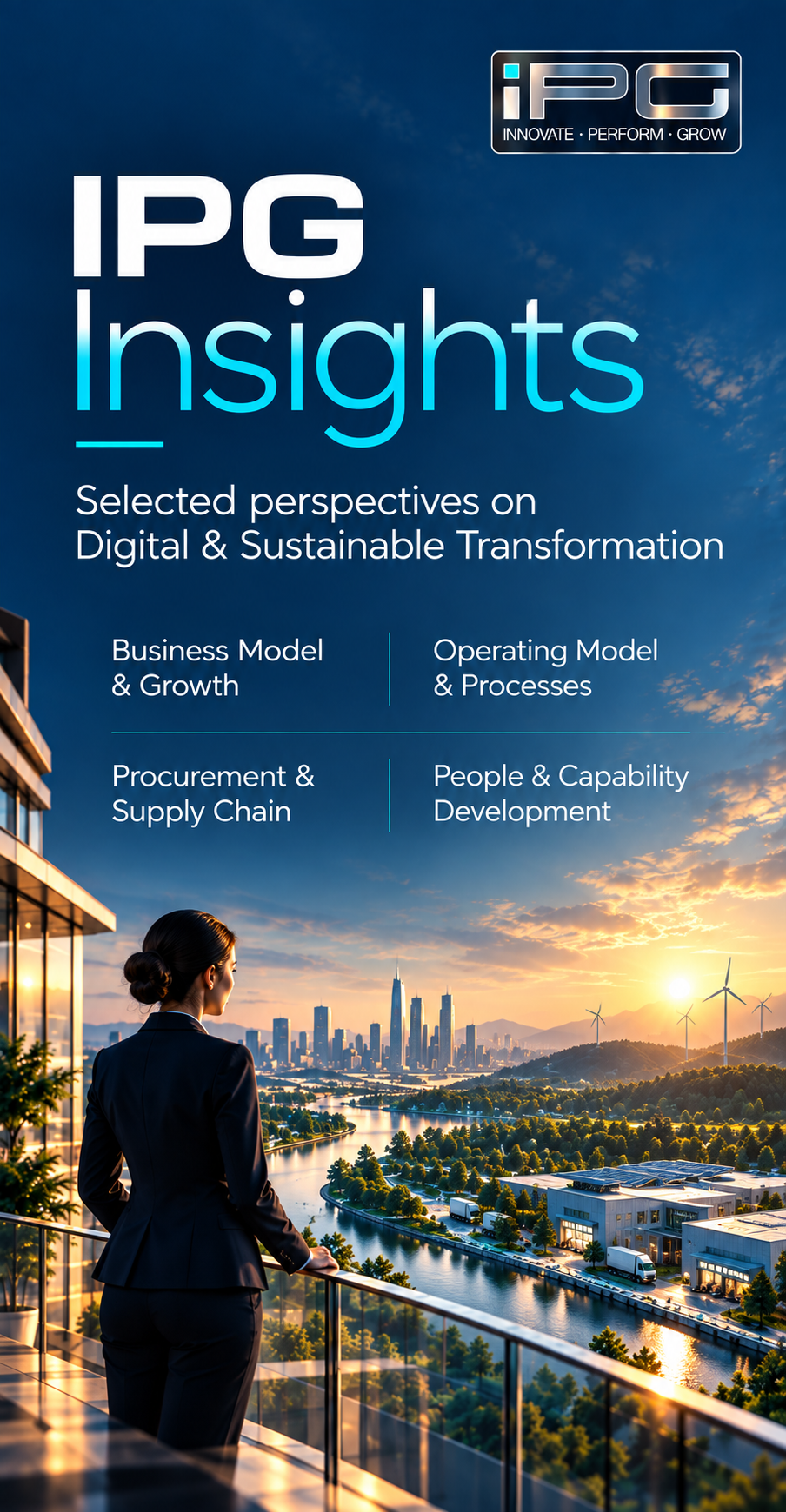
IPG INSIGHTS

Transformation insights
worth your time.

Selected perspectives on Digital & Sustainable Transformation, Business Model & Growth, Operating Model & Processes, Procurement & Supply Chain and People & Capability Development — directly to your inbox.

IPG Insights Newsletter Popup